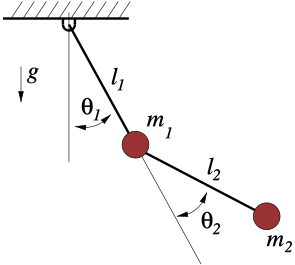
Recently, I have been expanding my knowledge in control theory by following Russ Tedrake ’s MIT 6.8210: Underactuated Robotics . This blog post is an “expansion” on the Simple Double Pendulum found in the Appendix B Multi-Body Dynamics.
Returning from the industry after working as a software engineer at Autodesk, I realized I had forgotten a lot of the math I learned in school. Therefore, I saw this as a perfect opportunity to take the given equations and derive them step by step. It serves as a great, hands-on refresher for calculus, partial derivatives, and applying the chain rule.
Problem
The example in Russ’s notes is stated as follows:
Consider the simple double pendulum with torque actuation at both joints and all of the mass concentrated in two points (for simplicity). Using q = [ θ 1 , θ 2 ] T \mathbf{q} = [\theta_1,\theta_2]^T q = [ θ 1 , θ 2 ] T p 1 , p 2 \mathbf{p}_1,\mathbf{p}_2 p 1 , p 2 m 1 , m 2 m_1,m_2 m 1 , m 2
What are the p 1 , p 2 \mathbf{p}_1,\mathbf{p}_2 p 1 , p 2
🗣Answer
Let’s tackle the p 1 \mathbf{p}_1 p 1 p 1 \mathbf{p}_1 p 1
p 1 = [ l 1 sin ( θ 1 ) − l 1 cos ( θ 1 ) ] . \mathbf{p}_1 =
\begin{bmatrix}
l_1 \sin(\theta_1) \\ -l_1\cos(\theta_1)
\end{bmatrix}. p 1 = [ l 1 sin ( θ 1 ) − l 1 cos ( θ 1 ) ] . The p 2 \mathbf{p}_2 p 2 p 1 \mathbf{p}_1 p 1
p 2 = p 1 + [ l 2 sin ( θ 1 + θ 2 ) − l 2 cos ( θ 1 + θ 2 ) ] . \mathbf{p}_2 =
\mathbf{p}_1 +
\begin{bmatrix}
l_2 \sin(\theta_1 + \theta_2) \\ -l_2\cos(\theta_1+\theta_2)
\end{bmatrix}. p 2 = p 1 + [ l 2 sin ( θ 1 + θ 2 ) − l 2 cos ( θ 1 + θ 2 ) ] . What are the velocities p ˙ 1 , p ˙ 2 \dot{\mathbf{p}}_1,\dot{\mathbf{p}}_2 p ˙ 1 , p ˙ 2
🗣Answer
Let’s find p ˙ 1 \dot{\mathbf{p}}_1 p ˙ 1
p ˙ 1 = d d t p 1 = [ l 1 θ 1 ˙ cos ( θ 1 ) l 1 θ 1 ˙ sin ( θ 1 ) ] . \dot{\mathbf{p}}_1 = \frac{d}{dt}\mathbf{p}_1 =
\begin{bmatrix}
l_1\dot{\theta_1} \cos(\theta_1) \\ l_1\dot{\theta_1}\sin(\theta_1)
\end{bmatrix}. p ˙ 1 = d t d p 1 = [ l 1 θ 1 ˙ cos ( θ 1 ) l 1 θ 1 ˙ sin ( θ 1 ) ] . This requires the chain rule . Because sin ( θ 1 ) \sin(\theta_1) sin ( θ 1 ) θ 1 \theta_1 θ 1 θ 1 \theta_1 θ 1 t t t t t t θ 1 \theta_1 θ 1 composite function . Think of it like this standard form:
d w d t = d w d x ⋅ d x d t {dw\over dt}={dw\over dx}\cdot{dx\over dt} d t d w = d x d w ⋅ d t d x Here, w = sin ( θ 1 ) w = \sin(\theta_1) w = sin ( θ 1 ) x = θ 1 ( t ) x = \theta_1(t) x = θ 1 ( t ) sin ( θ 1 ) \sin(\theta_1) sin ( θ 1 )
d d t sin ( θ 1 ) = d sin ( θ 1 ) d θ 1 ⋅ d θ 1 d t = cos ( θ 1 ) ⋅ θ ˙ 1 \frac{d}{dt}\sin(\theta_1) = \frac{d\sin(\theta_1)}{d\theta_1} \cdot \frac{d\theta_1}{dt} = \cos(\theta_1) \cdot \dot{\theta}_1 d t d sin ( θ 1 ) = d θ 1 d sin ( θ 1 ) ⋅ d t d θ 1 = cos ( θ 1 ) ⋅ θ ˙ 1 Now let’s tackle p ˙ 2 \dot{\mathbf{p}}_2 p ˙ 2
p 2 ˙ = p 1 ˙ + [ l 2 ( θ 1 ˙ + θ 2 ˙ ) cos ( θ 1 + θ 2 ) l 2 ( θ 1 ˙ + θ 2 ˙ ) sin ( θ 1 + θ 2 ) ] . \dot{\mathbf{p}_2} =
\dot{\mathbf{p}_1} +
\begin{bmatrix}
l_2(\dot{\theta_1} + \dot{\theta_2}) \cos(\theta_1 + \theta_2) \\ l_2(\dot{\theta_1} + \dot{\theta_2})\sin(\theta_1+\theta_2)
\end{bmatrix}. p 2 ˙ = p 1 ˙ + [ l 2 ( θ 1 ˙ + θ 2 ˙ ) cos ( θ 1 + θ 2 ) l 2 ( θ 1 ˙ + θ 2 ˙ ) sin ( θ 1 + θ 2 ) ] . What is the Kinetic Energy T T T
🗣Answer
To use the Euler-Lagrange equation , we first need to find T T T kinetic energy equation is
T = 1 2 m v 2 . T = \frac{1}{2}mv^2. T = 2 1 m v 2 . For 2 masses, this translates to:
T = 1 2 m 1 p ˙ 1 T p ˙ 1 + 1 2 m 2 p ˙ 2 T p ˙ 2 . T = \frac{1}{2} m_1 \dot{\bf p}_1^T \dot{\bf p}_1 + \frac{1}{2} m_2
\dot{\bf p}_2^T \dot{\bf p}_2 . T = 2 1 m 1 p ˙ 1 T p ˙ 1 + 2 1 m 2 p ˙ 2 T p ˙ 2 . Notice the matrix trick here: v 2 v^2 v 2 p ˙ T p ˙ \dot{\mathbf{p}}^T \dot{\mathbf{p}} p ˙ T p ˙
p ˙ 1 T p ˙ 1 = [ l 1 θ 1 ˙ cos ( θ 1 ) l 1 θ 1 ˙ sin ( θ 1 ) ] [ l 1 θ 1 ˙ cos ( θ 1 ) l 1 θ 1 ˙ sin ( θ 1 ) ] = l 1 2 θ 1 2 ˙ cos 2 ( θ 1 ) + l 1 2 θ 1 2 ˙ sin 2 ( θ 1 ) = l 1 2 θ 1 2 ˙ \begin{align}
\dot{\bf p}_1^T \dot{\bf p}_1 &=
\begin{bmatrix}
l_1\dot{\theta_1} \cos(\theta_1) & l_1\dot{\theta_1}\sin(\theta_1)
\end{bmatrix}
\begin{bmatrix}
l_1\dot{\theta_1} \cos(\theta_1) \\ l_1\dot{\theta_1}\sin(\theta_1)
\end{bmatrix}
\\
&= l_1^2\dot{\theta_1^2}\cos^2(\theta_1) + l_1^2\dot{\theta_1^2}\sin^2(\theta_1)
\\
&= l_1^2\dot{\theta_1^2}
\end{align} p ˙ 1 T p ˙ 1 = [ l 1 θ 1 ˙ cos ( θ 1 ) l 1 θ 1 ˙ sin ( θ 1 ) ] [ l 1 θ 1 ˙ cos ( θ 1 ) l 1 θ 1 ˙ sin ( θ 1 ) ] = l 1 2 θ 1 2 ˙ cos 2 ( θ 1 ) + l 1 2 θ 1 2 ˙ sin 2 ( θ 1 ) = l 1 2 θ 1 2 ˙ Next, we expand p ˙ 2 T p ˙ 2 \dot{\bf p}_2^T \dot{\bf p}_2 p ˙ 2 T p ˙ 2
p ˙ 2 T p ˙ 2 = ( l 1 θ ˙ 1 cos ( θ 1 ) + l 2 ( θ ˙ 1 + θ ˙ 2 ) cos ( θ 1 + θ 2 ) ) 2 + ( l 1 θ ˙ 1 sin ( θ 1 ) + l 2 ( θ ˙ 1 + θ ˙ 2 ) sin ( θ 1 + θ 2 ) ) 2 = ( l 1 θ ˙ 1 cos ( θ 1 ) ) 2 ⏟ Term A + 2 ⋅ l 1 θ ˙ 1 cos ( θ 1 ) ⋅ l 2 ( θ ˙ 1 + θ ˙ 2 ) cos ( θ 1 + θ 2 ) ⏟ Cross term X + ( l 2 ( θ ˙ 1 + θ ˙ 2 ) cos ( θ 1 + θ 2 ) ) 2 ⏟ Term B + ( l 1 θ ˙ 1 sin ( θ 1 ) ) 2 ⏟ Term C + 2 ⋅ l 1 θ ˙ 1 sin ( θ 1 ) ⋅ l 2 ( θ ˙ 1 + θ ˙ 2 ) sin ( θ 1 + θ 2 ) ⏟ Cross term Y + ( l 2 ( θ ˙ 1 + θ ˙ 2 ) sin ( θ 1 + θ 2 ) ) 2 ⏟ Term D = l 1 2 θ ˙ 1 2 cos 2 ( θ 1 ) + 2 l 1 l 2 θ ˙ 1 ( θ ˙ 1 + θ ˙ 2 ) cos ( θ 1 ) cos ( θ 1 + θ 2 ) + l 2 2 ( θ ˙ 1 + θ ˙ 2 ) 2 cos 2 ( θ 1 + θ 2 ) + l 1 2 θ ˙ 1 2 sin 2 ( θ 1 ) + 2 l 1 l 2 θ ˙ 1 ( θ ˙ 1 + θ ˙ 2 ) sin ( θ 1 ) sin ( θ 1 + θ 2 ) + l 2 2 ( θ ˙ 1 + θ ˙ 2 ) 2 sin 2 ( θ 1 + θ 2 ) = l 1 2 θ ˙ 1 2 ( cos 2 ( θ 1 ) + sin 2 ( θ 1 ) ) ⏟ Use: cos 2 α + sin 2 α = 1 + l 2 2 ( θ ˙ 1 + θ ˙ 2 ) 2 ( cos 2 ( θ 1 + θ 2 ) + sin 2 ( θ 1 + θ 2 ) ) ⏟ Use: cos 2 β + sin 2 β = 1 + 2 l 1 l 2 θ ˙ 1 ( θ ˙ 1 + θ ˙ 2 ) ( cos ( θ 1 ) cos ( θ 1 + θ 2 ) + sin ( θ 1 ) sin ( θ 1 + θ 2 ) ) ⏟ Use: cos ( α − β ) = cos α cos β + sin α sin β = l 1 2 θ ˙ 1 2 ⋅ \cancelto 1 ( cos 2 ( θ 1 ) + sin 2 ( θ 1 ) ) + l 2 2 ( θ ˙ 1 + θ ˙ 2 ) 2 ⋅ \cancelto 1 ( cos 2 ( θ 1 + θ 2 ) + sin 2 ( θ 1 + θ 2 ) ) + 2 l 1 l 2 θ ˙ 1 ( θ ˙ 1 + θ ˙ 2 ) ⋅ cos ( θ 1 − ( θ 1 + θ 2 ) ) ⏟ α = θ 1 , β = θ 1 + θ 2 = l 1 2 θ ˙ 1 2 + l 2 2 ( θ ˙ 1 + θ ˙ 2 ) 2 + 2 l 1 l 2 θ ˙ 1 ( θ ˙ 1 + θ ˙ 2 ) cos ( θ 1 − θ 1 − θ 2 ) = l 1 2 θ ˙ 1 2 + l 2 2 ( θ ˙ 1 + θ ˙ 2 ) 2 + 2 l 1 l 2 θ ˙ 1 ( θ ˙ 1 + θ ˙ 2 ) cos ( θ 2 ) \begin{align}
\dot{\mathbf{p}}_2^T \dot{\mathbf{p}}_2 &=
\left(
l_1\dot{\theta}_1 \cos(\theta_1) +l_2(\dot{\theta}_1 + \dot{\theta}_2) \cos(\theta_1 + \theta_2)
\right)^2
+
\left(
l_1\dot{\theta}_1\sin(\theta_1) +l_2(\dot{\theta}_1 + \dot{\theta}_2)\sin(\theta_1+\theta_2)
\right)^2
\\[10pt]
&= \underbrace{\left(l_1\dot{\theta}_1 \cos(\theta_1)\right)^2}_{\text{Term A}}
+ \underbrace{2 \cdot l_1\dot{\theta}_1 \cos(\theta_1) \cdot l_2(\dot{\theta}_1 + \dot{\theta}_2) \cos(\theta_1 + \theta_2)}_{\text{Cross term X}}
+ \underbrace{\left(l_2(\dot{\theta}_1 + \dot{\theta}_2) \cos(\theta_1 + \theta_2)\right)^2}_{\text{Term B}}
\\[4pt]
&\quad + \underbrace{\left(l_1\dot{\theta}_1\sin(\theta_1)\right)^2}_{\text{Term C}}
+ \underbrace{2 \cdot l_1\dot{\theta}_1\sin(\theta_1) \cdot l_2(\dot{\theta}_1 + \dot{\theta}_2)\sin(\theta_1+\theta_2)}_{\text{Cross term Y}}
+ \underbrace{\left(l_2(\dot{\theta}_1 + \dot{\theta}_2)\sin(\theta_1+\theta_2)\right)^2}_{\text{Term D}}
\\[10pt]
&= l_1^2\dot{\theta}_1^2\cos^2(\theta_1)
+ 2l_1l_2\dot{\theta}_1(\dot{\theta}_1 + \dot{\theta}_2)\cos(\theta_1)\cos(\theta_1+\theta_2)
+ l_2^2(\dot{\theta}_1 + \dot{\theta}_2)^2\cos^2(\theta_1+\theta_2)
\\[4pt]
&\quad + l_1^2\dot{\theta}_1^2\sin^2(\theta_1)
+ 2l_1l_2\dot{\theta}_1(\dot{\theta}_1 + \dot{\theta}_2)\sin(\theta_1)\sin(\theta_1+\theta_2)
+ l_2^2(\dot{\theta}_1 + \dot{\theta}_2)^2\sin^2(\theta_1+\theta_2)
\\[10pt]
&= \underbrace{l_1^2\dot{\theta}_1^2\Big(\cos^2(\theta_1) + \sin^2(\theta_1)\Big)}_{\text{Use: }\cos^2\alpha + \sin^2\alpha = 1}
+ \underbrace{l_2^2(\dot{\theta}_1 + \dot{\theta}_2)^2\Big(\cos^2(\theta_1+\theta_2) + \sin^2(\theta_1+\theta_2)\Big)}_{\text{Use: }\cos^2\beta + \sin^2\beta = 1}
\\[4pt]
&\quad + \underbrace{2l_1l_2\dot{\theta}_1(\dot{\theta}_1 + \dot{\theta}_2)\Big(\cos(\theta_1)\cos(\theta_1+\theta_2) + \sin(\theta_1)\sin(\theta_1+\theta_2)\Big)}_{\text{Use: }\cos(\alpha-\beta) = \cos\alpha\cos\beta + \sin\alpha\sin\beta}
\\[10pt]
&= l_1^2\dot{\theta}_1^2 \cdot \cancelto{1}{\Big(\cos^2(\theta_1) + \sin^2(\theta_1)\Big)}
+ l_2^2(\dot{\theta}_1 + \dot{\theta}_2)^2 \cdot \cancelto{1}{\Big(\cos^2(\theta_1+\theta_2) + \sin^2(\theta_1+\theta_2)\Big)}
\\[4pt]
&\quad + 2l_1l_2\dot{\theta}_1(\dot{\theta}_1 + \dot{\theta}_2) \cdot \underbrace{\cos\Big(\theta_1 - (\theta_1+\theta_2)\Big)}_{\alpha = \theta_1,\, \beta = \theta_1+\theta_2}
\\[10pt]
&= l_1^2\dot{\theta}_1^2 + l_2^2(\dot{\theta}_1 + \dot{\theta}_2)^2 + 2l_1l_2\dot{\theta}_1(\dot{\theta}_1 + \dot{\theta}_2)\cos(\cancel{\theta_1} - \cancel{\theta_1} - \theta_2)
\\[10pt]
&= \boxed{l_1^2\dot{\theta}_1^2 + l_2^2(\dot{\theta}_1 + \dot{\theta}_2)^2 + 2l_1l_2\dot{\theta}_1(\dot{\theta}_1 + \dot{\theta}_2)\cos(\theta_2)}
\end{align} p ˙ 2 T p ˙ 2 = ( l 1 θ ˙ 1 cos ( θ 1 ) + l 2 ( θ ˙ 1 + θ ˙ 2 ) cos ( θ 1 + θ 2 ) ) 2 + ( l 1 θ ˙ 1 sin ( θ 1 ) + l 2 ( θ ˙ 1 + θ ˙ 2 ) sin ( θ 1 + θ 2 ) ) 2 = Term A ( l 1 θ ˙ 1 cos ( θ 1 ) ) 2 + Cross term X 2 ⋅ l 1 θ ˙ 1 cos ( θ 1 ) ⋅ l 2 ( θ ˙ 1 + θ ˙ 2 ) cos ( θ 1 + θ 2 ) + Term B ( l 2 ( θ ˙ 1 + θ ˙ 2 ) cos ( θ 1 + θ 2 ) ) 2 + Term C ( l 1 θ ˙ 1 sin ( θ 1 ) ) 2 + Cross term Y 2 ⋅ l 1 θ ˙ 1 sin ( θ 1 ) ⋅ l 2 ( θ ˙ 1 + θ ˙ 2 ) sin ( θ 1 + θ 2 ) + Term D ( l 2 ( θ ˙ 1 + θ ˙ 2 ) sin ( θ 1 + θ 2 ) ) 2 = l 1 2 θ ˙ 1 2 cos 2 ( θ 1 ) + 2 l 1 l 2 θ ˙ 1 ( θ ˙ 1 + θ ˙ 2 ) cos ( θ 1 ) cos ( θ 1 + θ 2 ) + l 2 2 ( θ ˙ 1 + θ ˙ 2 ) 2 cos 2 ( θ 1 + θ 2 ) + l 1 2 θ ˙ 1 2 sin 2 ( θ 1 ) + 2 l 1 l 2 θ ˙ 1 ( θ ˙ 1 + θ ˙ 2 ) sin ( θ 1 ) sin ( θ 1 + θ 2 ) + l 2 2 ( θ ˙ 1 + θ ˙ 2 ) 2 sin 2 ( θ 1 + θ 2 ) = Use: c o s 2 α + s i n 2 α = 1 l 1 2 θ ˙ 1 2 ( cos 2 ( θ 1 ) + sin 2 ( θ 1 ) ) + Use: c o s 2 β + s i n 2 β = 1 l 2 2 ( θ ˙ 1 + θ ˙ 2 ) 2 ( cos 2 ( θ 1 + θ 2 ) + sin 2 ( θ 1 + θ 2 ) ) + Use: c o s ( α − β ) = c o s α c o s β + s i n α s i n β 2 l 1 l 2 θ ˙ 1 ( θ ˙ 1 + θ ˙ 2 ) ( cos ( θ 1 ) cos ( θ 1 + θ 2 ) + sin ( θ 1 ) sin ( θ 1 + θ 2 ) ) = l 1 2 θ ˙ 1 2 ⋅ \cancelto 1 ( cos 2 ( θ 1 ) + sin 2 ( θ 1 ) ) + l 2 2 ( θ ˙ 1 + θ ˙ 2 ) 2 ⋅ \cancelto 1 ( cos 2 ( θ 1 + θ 2 ) + sin 2 ( θ 1 + θ 2 ) ) + 2 l 1 l 2 θ ˙ 1 ( θ ˙ 1 + θ ˙ 2 ) ⋅ α = θ 1 , β = θ 1 + θ 2 cos ( θ 1 − ( θ 1 + θ 2 ) ) = l 1 2 θ ˙ 1 2 + l 2 2 ( θ ˙ 1 + θ ˙ 2 ) 2 + 2 l 1 l 2 θ ˙ 1 ( θ ˙ 1 + θ ˙ 2 ) cos ( θ 1 − θ 1 − θ 2 ) = l 1 2 θ ˙ 1 2 + l 2 2 ( θ ˙ 1 + θ ˙ 2 ) 2 + 2 l 1 l 2 θ ˙ 1 ( θ ˙ 1 + θ ˙ 2 ) cos ( θ 2 )
Remark
The preceding derivation uses the following trigonometric identities:
cos 2 α + sin 2 α = 1 \cos^2\alpha + \sin^2\alpha = 1 cos 2 α + sin 2 α = 1 cos ( α − β ) = cos α cos β + sin α sin β \cos(\alpha-\beta) = \cos\alpha\cos\beta + \sin\alpha\sin\beta cos ( α − β ) = cos α cos β + sin α sin β cos ( − θ ) = cos ( θ ) \cos(-\theta) = \cos(\theta) cos ( − θ ) = cos ( θ )
Let’s wrap up T T T
T = 1 2 m 1 p ˙ 1 T p ˙ 1 + 1 2 m 2 p ˙ 2 T p ˙ 2 = 1 2 m 1 l 1 2 θ 1 2 ˙ + 1 2 m 2 ( l 1 2 θ ˙ 1 2 + l 2 2 ( θ ˙ 1 + θ ˙ 2 ) 2 + 2 l 1 l 2 θ ˙ 1 ( θ ˙ 1 + θ ˙ 2 ) cos ( θ 2 ) ) = 1 2 ( m 1 + m 2 ) l 1 2 θ ˙ 1 2 + 1 2 m 2 l 2 2 ( θ ˙ 1 + θ ˙ 2 ) 2 + m 2 l 1 l 2 θ ˙ 1 ( θ ˙ 1 + θ ˙ 2 ) cos ( θ 2 ) \begin{align}
T &= \frac{1}{2} m_1 \dot{\bf p}_1^T \dot{\bf p}_1 + \frac{1}{2} m_2
\dot{\bf p}_2^T \dot{\bf p}_2\\
&= \frac{1}{2} m_1 l_1^2\dot{\theta_1^2} + \frac{1}{2} m_2 (l_1^2\dot{\theta}_1^2 + l_2^2(\dot{\theta}_1 + \dot{\theta}_2)^2 + 2l_1l_2\dot{\theta}_1(\dot{\theta}_1 + \dot{\theta}_2)\cos(\theta_2))
\\
=& \frac{1}{2}(m_1 + m_2) l_1^2 \dot{\theta}_1^2 + \frac{1}{2} m_2 l_2^2 (\dot{\theta}_1 + \dot{\theta}_2)^2 + m_2 l_1 l_2 \dot{\theta}_1 (\dot{\theta}_1 + \dot{\theta}_2) \cos(\theta_2)
\end{align} T = = 2 1 m 1 p ˙ 1 T p ˙ 1 + 2 1 m 2 p ˙ 2 T p ˙ 2 = 2 1 m 1 l 1 2 θ 1 2 ˙ + 2 1 m 2 ( l 1 2 θ ˙ 1 2 + l 2 2 ( θ ˙ 1 + θ ˙ 2 ) 2 + 2 l 1 l 2 θ ˙ 1 ( θ ˙ 1 + θ ˙ 2 ) cos ( θ 2 )) 2 1 ( m 1 + m 2 ) l 1 2 θ ˙ 1 2 + 2 1 m 2 l 2 2 ( θ ˙ 1 + θ ˙ 2 ) 2 + m 2 l 1 l 2 θ ˙ 1 ( θ ˙ 1 + θ ˙ 2 ) cos ( θ 2 ) What is the Potential Engergy U U U
🗣Answer
For potential energy from gravity, the standard expression is
U = m g h . U = mgh. U = m g h . The height for each mass can be easily found using trigonometric function:
U = m 1 g y 1 + m 2 g y 2 = − m 1 g l 1 cos ( θ 1 ) − m 2 g ( l 1 cos ( θ 1 ) + l 2 cos ( θ 1 + θ 2 ) ) = − m 1 g l 1 cos ( θ 1 ) − m 2 g l 1 cos ( θ 1 ) − m 2 g l 2 cos ( θ 1 + θ 2 ) = − ( m 1 + m 2 ) g l 1 cos ( θ 1 ) − m 2 g l 2 cos ( θ 1 + θ 2 ) \begin{align}
U &= m_1 g y_1 + m_2 g y_2 \\
&= -m_1 g l_1\cos(\theta_1) - m_2g\bigg(l_1 \cos(\theta_1) + l_2\cos(\theta_1 + \theta_2)\bigg) \\
&= -m_1 g l_1\cos(\theta_1) - m_2g l_1 \cos(\theta_1) - m_2g l_2\cos(\theta_1 + \theta_2) \\
&= -(m_1 + m_2) g l_1 \cos(\theta_1) - m_2g l_2\cos(\theta_1 + \theta_2)
\end{align} U = m 1 g y 1 + m 2 g y 2 = − m 1 g l 1 cos ( θ 1 ) − m 2 g ( l 1 cos ( θ 1 ) + l 2 cos ( θ 1 + θ 2 ) ) = − m 1 g l 1 cos ( θ 1 ) − m 2 g l 1 cos ( θ 1 ) − m 2 g l 2 cos ( θ 1 + θ 2 ) = − ( m 1 + m 2 ) g l 1 cos ( θ 1 ) − m 2 g l 2 cos ( θ 1 + θ 2 ) Applying the Euler-Lagrange Equation
In Lagrangian mechanics , the Lagrangian is defined as
L = T − U , L = T - U, L = T − U , The Euler-Lagrange equation dictates the dynamics:
d d t ( ∂ L ∂ q ˙ i ) − ∂ L ∂ q i = τ i . \frac{d}{dt}\left(\frac{\partial L}{\partial \dot{q}_i}\right) - \frac{\partial L}{\partial q_i} = \tau_i. d t d ( ∂ q ˙ i ∂ L ) − ∂ q i ∂ L = τ i . Because our expressions are complicated, separating T T T U U U
d d t ( ∂ T ∂ q ˙ i − ∂ U ∂ q ˙ i ) − ( ∂ T ∂ q i − ∂ U ∂ q i ) = τ i . \frac{d}{dt}\left(\frac{\partial T}{\partial \dot{q}_i} - \frac{\partial U}{\partial \dot{q}_i}\right) - \left(\frac{\partial T}{\partial q_i} - \frac{\partial U}{\partial q_i}\right) = \tau_i. d t d ( ∂ q ˙ i ∂ T − ∂ q ˙ i ∂ U ) − ( ∂ q i ∂ T − ∂ q i ∂ U ) = τ i . Solving for Torque τ 1 \tau_1 τ 1
Let’s systematically derive the equation for τ 1 \tau_1 τ 1
d d t ( ∂ T ∂ θ ˙ 1 − ∂ U ∂ θ ˙ 1 ) − ( ∂ T ∂ θ 1 − ∂ U ∂ θ 1 ) = τ 1 , \frac{d}{dt}\left(\frac{\partial T}{\partial \dot{\theta}_1} - \frac{\partial U}{\partial \dot{\theta}_1}\right) - \left(\frac{\partial T}{\partial \theta_1} - \frac{\partial U}{\partial \theta_1}\right) = \tau_1, d t d ( ∂ θ ˙ 1 ∂ T − ∂ θ ˙ 1 ∂ U ) − ( ∂ θ 1 ∂ T − ∂ θ 1 ∂ U ) = τ 1 , given
T = 1 2 ( m 1 + m 2 ) l 1 2 θ ˙ 1 2 + 1 2 m 2 l 2 2 ( θ ˙ 1 + θ ˙ 2 ) 2 + m 2 l 1 l 2 θ ˙ 1 ( θ ˙ 1 + θ ˙ 2 ) cos ( θ 2 ) , U = − ( m 1 + m 2 ) g l 1 cos ( θ 1 ) − m 2 g l 2 cos ( θ 1 + θ 2 ) . \begin{align}
T &= \frac{1}{2}(m_1 + m_2) l_1^2 \dot{\theta}_1^2 + \frac{1}{2} m_2 l_2^2 (\dot{\theta}_1 + \dot{\theta}_2)^2 + m_2 l_1 l_2 \dot{\theta}_1 (\dot{\theta}_1 + \dot{\theta}_2) \cos(\theta_2),\\
U &= -(m_1 + m_2) g l_1 \cos(\theta_1) - m_2g l_2\cos(\theta_1 + \theta_2).
\end{align} T U = 2 1 ( m 1 + m 2 ) l 1 2 θ ˙ 1 2 + 2 1 m 2 l 2 2 ( θ ˙ 1 + θ ˙ 2 ) 2 + m 2 l 1 l 2 θ ˙ 1 ( θ ˙ 1 + θ ˙ 2 ) cos ( θ 2 ) , = − ( m 1 + m 2 ) g l 1 cos ( θ 1 ) − m 2 g l 2 cos ( θ 1 + θ 2 ) . 📌calculate ∂ U ∂ θ ˙ 1 \displaystyle \frac{\partial U}{\partial \dot{\theta}_1} ∂ θ ˙ 1 ∂ U
Since there is no θ ˙ 1 \dot{\theta}_1 θ ˙ 1 U U U
∂ U ∂ θ ˙ 1 = 0. \frac{\partial U}{\partial \dot{\theta}_1}=0. ∂ θ ˙ 1 ∂ U = 0. 📌calculate ∂ T ∂ θ 1 \displaystyle \frac{\partial T}{\partial {\theta}_1} ∂ θ 1 ∂ T
Since there is no θ 1 {\theta}_1 θ 1 T T T
∂ T ∂ θ 1 = 0. \frac{\partial T}{\partial {\theta}_1} = 0. ∂ θ 1 ∂ T = 0. 📌calculate ∂ U ∂ θ 1 \displaystyle \frac{\partial U}{\partial \theta_1} ∂ θ 1 ∂ U
Treat θ 2 \theta_2 θ 2 cos ( x ) \cos(x) cos ( x ) − sin ( x ) -\sin(x) − sin ( x ) ( θ 1 + θ 2 ) (\theta_1 + \theta_2) ( θ 1 + θ 2 ) θ 1 \theta_1 θ 1 1 1 1
∂ U ∂ θ 1 = ( m 1 + m 2 ) g l 1 sin ( θ 1 ) + m 2 g l 2 sin ( θ 1 + θ 2 ) ⋅ ( θ 1 + θ 2 ) ′ = ( m 1 + m 2 ) g l 1 sin ( θ 1 ) + m 2 g l 2 sin ( θ 1 + θ 2 ) ⋅ ( 1 ) = ( m 1 + m 2 ) g l 1 sin ( θ 1 ) + m 2 g l 2 sin ( θ 1 + θ 2 ) \begin{align}
\frac{\partial U}{\partial \theta_1} &= (m1 + m_2)gl_1 \sin(\theta_1) + m_2 g l_2 \sin(\theta_{1}+\theta_{2})\cdot(\theta_{1}+\theta_{2})' \tag{chain rule} \\
&= (m1 + m_2)gl_1 \sin(\theta_1) + m_2 g l_2 \sin(\theta_{1}+\theta_{2})\cdot(1) \\
&= (m1 + m_2)gl_1 \sin(\theta_1) + m_2 g l_2 \sin(\theta_{1}+\theta_{2}) \\
\end{align} ∂ θ 1 ∂ U = ( m 1 + m 2 ) g l 1 sin ( θ 1 ) + m 2 g l 2 sin ( θ 1 + θ 2 ) ⋅ ( θ 1 + θ 2 ) ′ = ( m 1 + m 2 ) g l 1 sin ( θ 1 ) + m 2 g l 2 sin ( θ 1 + θ 2 ) ⋅ ( 1 ) = ( m 1 + m 2 ) g l 1 sin ( θ 1 ) + m 2 g l 2 sin ( θ 1 + θ 2 ) ( chain rule ) 📌calculate ∂ T ∂ θ ˙ 1 \displaystyle \frac{\partial T}{\partial \dot{\theta}_1} ∂ θ ˙ 1 ∂ T
∂ T ∂ θ ˙ 1 = ∂ ∂ θ ˙ 1 ( 1 2 ( m 1 + m 2 ) l 1 2 θ ˙ 1 2 ⏟ 1 + 1 2 m 2 l 2 2 ( θ ˙ 1 + θ ˙ 2 ) 2 ⏟ 2 + m 2 l 1 l 2 θ ˙ 1 ( θ ˙ 1 + θ ˙ 2 ) cos ( θ 2 ) ⏟ 3 ) \begin{align}
\frac{\partial T}{\partial \dot{\theta}_1}
&=\frac{\partial}{\partial \dot{\theta}_1}
\left(
\underbrace
{\frac{1}{2}(m_1 + m_2) l_1^2 \dot{\theta}_1^2}_\text{1} +
\underbrace{\frac{1}{2} m_2 l_2^2 (\dot{\theta}_1 + \dot{\theta}_2)^2}_\text{2} +
\underbrace{m_2 l_1 l_2 \dot{\theta}_1 (\dot{\theta}_1 + \dot{\theta}_2) \cos(\theta_2)}_\text{3}
\right)
\end{align} ∂ θ ˙ 1 ∂ T = ∂ θ ˙ 1 ∂ 1 2 1 ( m 1 + m 2 ) l 1 2 θ ˙ 1 2 + 2 2 1 m 2 l 2 2 ( θ ˙ 1 + θ ˙ 2 ) 2 + 3 m 2 l 1 l 2 θ ˙ 1 ( θ ˙ 1 + θ ˙ 2 ) cos ( θ 2 ) (1) first term:
∂ ∂ θ ˙ 1 ( 1 2 ( m 1 + m 2 ) l 1 2 θ ˙ 1 2 ) = ( m 1 + m 2 ) l 1 2 θ ˙ 1 \begin{align}
\frac{\partial}{\partial \dot{\theta}_1} (\frac{1}{2}(m_1 + m_2) l_1^2 \dot{\theta}_1^2) &= (m_1+m_2)l_1^2 \dot{\theta}_1
\end{align} ∂ θ ˙ 1 ∂ ( 2 1 ( m 1 + m 2 ) l 1 2 θ ˙ 1 2 ) = ( m 1 + m 2 ) l 1 2 θ ˙ 1 (2) second term:
∂ ∂ θ ˙ 1 ( 1 2 m 2 l 2 2 ( θ ˙ 1 + θ ˙ 2 ) 2 ) = m 2 l 2 2 ( θ ˙ 1 + θ ˙ 2 ) ⋅ ( θ ˙ 1 + θ ˙ 2 ) ′ = m 2 l 2 2 ( θ ˙ 1 + θ ˙ 2 ) \begin{align}
\frac{\partial}{\partial \dot{\theta}_1} (\frac{1}{2} m_2 l_2^2 (\dot{\theta}_1 + \dot{\theta}_2)^2) &= m_2 l_2^2 (\dot{\theta}_1 + \dot{\theta}_2) \cdot (\dot{\theta}_1 + \dot{\theta}_2)' \tag{chain rule}\\
&= m_2 l_2^2 (\dot{\theta}_1 + \dot{\theta}_2)
\end{align} ∂ θ ˙ 1 ∂ ( 2 1 m 2 l 2 2 ( θ ˙ 1 + θ ˙ 2 ) 2 ) = m 2 l 2 2 ( θ ˙ 1 + θ ˙ 2 ) ⋅ ( θ ˙ 1 + θ ˙ 2 ) ′ = m 2 l 2 2 ( θ ˙ 1 + θ ˙ 2 ) ( chain rule ) (3) third term:
We can treat m 2 l 1 l 2 cos ( θ 2 ) m_2 l_1 l_2 \cos(\theta_2) m 2 l 1 l 2 cos ( θ 2 ) d d t ( u ⋅ v ) = u ˙ v + u v ˙ \displaystyle \frac{d}{dt}(u \cdot v) = \dot{u}v + u\dot{v} d t d ( u ⋅ v ) = u ˙ v + u v ˙ θ ˙ 1 ( θ ˙ 1 + θ ˙ 2 ) \dot{\theta}_1 (\dot{\theta}_1 + \dot{\theta}_2) θ ˙ 1 ( θ ˙ 1 + θ ˙ 2 )
∂ ∂ θ ˙ 1 ( m 2 l 1 l 2 θ ˙ 1 ( θ ˙ 1 + θ ˙ 2 ) cos ( θ 2 ) ) = m 2 l 1 l 2 cos ( θ 2 ) ⋅ ( 1 ⋅ ( θ ˙ 1 + θ ˙ 2 ) + θ ˙ 1 ⋅ 1 ) = m 2 l 1 l 2 cos ( θ 2 ) ( 2 θ ˙ 1 + θ ˙ 2 ) \begin{align}
\frac{\partial}{\partial \dot{\theta}_1} (m_2 l_1 l_2 \dot{\theta}_1 (\dot{\theta}_1 + \dot{\theta}_2) \cos(\theta_2)) &= m_2 l_1 l_2 \cos(\theta_2) \cdot \left(1\cdot(\dot{\theta}_1 + \dot{\theta}_2)+\dot{\theta}_1\cdot1\right) \\
&= m_2 l_1 l_2 \cos(\theta_2) (2\dot{\theta}_1 + \dot{\theta}_2)
\end{align} ∂ θ ˙ 1 ∂ ( m 2 l 1 l 2 θ ˙ 1 ( θ ˙ 1 + θ ˙ 2 ) cos ( θ 2 )) = m 2 l 1 l 2 cos ( θ 2 ) ⋅ ( 1 ⋅ ( θ ˙ 1 + θ ˙ 2 ) + θ ˙ 1 ⋅ 1 ) = m 2 l 1 l 2 cos ( θ 2 ) ( 2 θ ˙ 1 + θ ˙ 2 ) (4) together:
Putting it all together, we get:
∂ T ∂ θ ˙ 1 = ( m 1 + m 2 ) l 1 2 θ ˙ 1 + m 2 l 2 2 ( θ ˙ 1 + θ ˙ 2 ) + m 2 l 1 l 2 ( 2 θ ˙ 1 + θ ˙ 2 ) cos ( θ 2 ) \begin{align}
\frac{\partial T}{\partial \dot{\theta}_1}
&= (m_1 + m_2)l_1^2 \dot{\theta}_1 + m_2 l_2^2 (\dot{\theta}_1 + \dot{\theta}_2) + m_2 l_1 l_2 (2\dot{\theta}_1 + \dot{\theta}_2) \cos(\theta_2)
\end{align} ∂ θ ˙ 1 ∂ T = ( m 1 + m 2 ) l 1 2 θ ˙ 1 + m 2 l 2 2 ( θ ˙ 1 + θ ˙ 2 ) + m 2 l 1 l 2 ( 2 θ ˙ 1 + θ ˙ 2 ) cos ( θ 2 ) 📌 Summarizing Our Progress
We have the following
∂ U ∂ θ ˙ 1 = 0 \displaystyle \frac{\partial U}{\partial \dot{\theta}_1}=0 ∂ θ ˙ 1 ∂ U = 0 ∂ T ∂ θ 1 = 0 \displaystyle \frac{\partial T}{\partial {\theta}_1} = 0 ∂ θ 1 ∂ T = 0 ∂ U ∂ θ 1 = ( m 1 + m 2 ) g l 1 sin ( θ 1 ) + m 2 g l 2 sin ( θ 1 + θ 2 ) \displaystyle \frac{\partial U}{\partial \theta_1} = (m1 + m_2)gl_1 \sin(\theta_1) + m_2 g l_2 \sin(\theta_{1}+\theta_{2}) ∂ θ 1 ∂ U = ( m 1 + m 2 ) g l 1 sin ( θ 1 ) + m 2 g l 2 sin ( θ 1 + θ 2 ) ∂ T ∂ θ ˙ 1 = ( m 1 + m 2 ) l 1 2 θ ˙ 1 + m 2 l 2 2 ( θ ˙ 1 + θ ˙ 2 ) + m 2 l 1 l 2 ( 2 θ ˙ 1 + θ ˙ 2 ) cos ( θ 2 ) \displaystyle \frac{\partial T}{\partial \dot{\theta}_1} = (m_1 + m_2)l_1^2 \dot{\theta}_1 + m_2 l_2^2 (\dot{\theta}_1 + \dot{\theta}_2) + m_2 l_1 l_2 (2\dot{\theta}_1 + \dot{\theta}_2) \cos(\theta_2) ∂ θ ˙ 1 ∂ T = ( m 1 + m 2 ) l 1 2 θ ˙ 1 + m 2 l 2 2 ( θ ˙ 1 + θ ˙ 2 ) + m 2 l 1 l 2 ( 2 θ ˙ 1 + θ ˙ 2 ) cos ( θ 2 )
Therefore, the
d d t ( ∂ T ∂ θ ˙ 1 − ∂ U ∂ θ ˙ 1 ) − ( ∂ T ∂ θ 1 − ∂ U ∂ θ 1 ) = τ 1 \frac{d}{dt}\left(\frac{\partial T}{\partial \dot{\theta}_1} - \frac{\partial U}{\partial \dot{\theta}_1}\right) - \left(\frac{\partial T}{\partial \theta_1} - \frac{\partial U}{\partial \theta_1}\right) = \tau_1 d t d ( ∂ θ ˙ 1 ∂ T − ∂ θ ˙ 1 ∂ U ) − ( ∂ θ 1 ∂ T − ∂ θ 1 ∂ U ) = τ 1 could be simplified to
d d t ( ∂ T ∂ θ ˙ 1 − ∂ U ∂ θ ˙ 1 ) − ( ∂ T ∂ θ 1 − ∂ U ∂ θ 1 ) = τ 1 , d d t ∂ T ∂ θ ˙ 1 + ∂ U ∂ θ 1 = τ 1 \begin{align}
\frac{d}{dt}\left(\frac{\partial T}{\partial \dot{\theta}_1} - \cancel{\frac{\partial U}{\partial \dot{\theta}_1}}\right) - \left(\cancel{\frac{\partial T}{\partial \theta_1}} - \frac{\partial U}{\partial \theta_1}\right) &= \tau_1, \\
\frac{d}{dt}\frac{\partial T}{\partial \dot{\theta}_1} + \frac{\partial U}{\partial \theta_1} = \tau_1
\end{align} d t d ( ∂ θ ˙ 1 ∂ T − ∂ θ ˙ 1 ∂ U ) − ( ∂ θ 1 ∂ T − ∂ θ 1 ∂ U ) d t d ∂ θ ˙ 1 ∂ T + ∂ θ 1 ∂ U = τ 1 = τ 1 , The last hurdle is calculating the time derivative:
d d t ∂ T ∂ θ ˙ 1 . \frac{d}{dt}\frac{\partial T}{\partial \dot{\theta}_1}. d t d ∂ θ ˙ 1 ∂ T . 📌calculate d d t ∂ T ∂ θ ˙ 1 \displaystyle \frac{d}{dt}\frac{\partial T}{\partial \dot{\theta}_1} d t d ∂ θ ˙ 1 ∂ T
d d t ∂ T ∂ θ ˙ 1 = d d t ( ( m 1 + m 2 ) l 1 2 θ ˙ 1 + m 2 l 2 2 ( θ ˙ 1 + θ ˙ 2 ) + m 2 l 1 l 2 ( 2 θ ˙ 1 + θ ˙ 2 ) cos ( θ 2 ) ) = ( m 1 + m 2 ) l 1 2 θ ¨ 1 + m 2 l 2 2 ( θ ¨ 1 + θ ¨ 2 ) + m 2 l 1 l 2 ( 2 θ ˙ 1 + θ ˙ 2 ) ′ cos ( θ 2 ) + m 2 l 1 l 2 ( 2 θ ˙ 1 + θ ˙ 2 ) cos ′ ( θ 2 ) = ( m 1 + m 2 ) l 1 2 θ ¨ 1 + m 2 l 2 2 ( θ ¨ 1 + θ ¨ 2 ) + m 2 l 1 l 2 ( 2 θ ¨ 1 + θ ¨ 2 ) cos ( θ 2 ) − m 2 l 1 l 2 ( 2 θ ˙ 1 + θ ˙ 2 ) sin ( θ 2 ) θ 2 ˙ \begin{align}
\frac{d}{dt}\frac{\partial T}{\partial \dot{\theta}_1} & = \frac{d}{dt} \left((m_1 + m_2)l_1^2 \dot{\theta}_1 + m_2 l_2^2 (\dot{\theta}_1 + \dot{\theta}_2) + m_2 l_1 l_2 (2\dot{\theta}_1 + \dot{\theta}_2) \cos(\theta_2)\right) \\
&= (m_1 + m_2)l_1^2 \ddot{\theta}_1 + m_2 l_2^2 (\ddot{\theta}_1 + \ddot{\theta}_2) + m_2 l_1 l_2 (2\dot{\theta}_1 + \dot{\theta}_2) '\cos(\theta_2) + m_2 l_1 l_2 (2\dot{\theta}_1 + \dot{\theta}_2) \cos'(\theta_2) \\
&= (m_1 + m_2)l_1^2 \ddot{\theta}_1 + m_2 l_2^2 (\ddot{\theta}_1 + \ddot{\theta}_2) + m_2 l_1 l_2 (2\ddot{\theta}_1 + \ddot{\theta}_2) \cos(\theta_2) - m_2 l_1 l_2 (2\dot{\theta}_1 + \dot{\theta}_2) \sin(\theta_2)\dot{\theta_2}
\end{align} d t d ∂ θ ˙ 1 ∂ T = d t d ( ( m 1 + m 2 ) l 1 2 θ ˙ 1 + m 2 l 2 2 ( θ ˙ 1 + θ ˙ 2 ) + m 2 l 1 l 2 ( 2 θ ˙ 1 + θ ˙ 2 ) cos ( θ 2 ) ) = ( m 1 + m 2 ) l 1 2 θ ¨ 1 + m 2 l 2 2 ( θ ¨ 1 + θ ¨ 2 ) + m 2 l 1 l 2 ( 2 θ ˙ 1 + θ ˙ 2 ) ′ cos ( θ 2 ) + m 2 l 1 l 2 ( 2 θ ˙ 1 + θ ˙ 2 ) cos ′ ( θ 2 ) = ( m 1 + m 2 ) l 1 2 θ ¨ 1 + m 2 l 2 2 ( θ ¨ 1 + θ ¨ 2 ) + m 2 l 1 l 2 ( 2 θ ¨ 1 + θ ¨ 2 ) cos ( θ 2 ) − m 2 l 1 l 2 ( 2 θ ˙ 1 + θ ˙ 2 ) sin ( θ 2 ) θ 2 ˙ The last term requires both
product rule: d d t ( u ⋅ v ) = u ˙ v + u v ˙ \displaystyle \frac{d}{dt}(u \cdot v) = \dot{u}v + u\dot{v} d t d ( u ⋅ v ) = u ˙ v + u v ˙
chain rule: d w d t = d w d x ⋅ d x d t \displaystyle {dw\over dt}={dw\over dx}\cdot{dx\over dt} d t d w = d x d w ⋅ d t d x
📌 Final Equation for τ 1 \tau_1 τ 1
τ 1 = ( m 1 + m 2 ) l 1 2 θ ¨ 1 + m 2 l 2 2 ( θ ¨ 1 + θ ¨ 2 ) + m 2 l 1 l 2 ( ( 2 θ ¨ 1 + θ ¨ 2 ) cos ( θ 2 ) − ( 2 θ ˙ 1 + θ ˙ 2 ) sin ( θ 2 ) θ ˙ 2 ) + ( m 1 + m 2 ) g l 1 sin ( θ 1 ) + m 2 g l 2 sin ( θ 1 + θ 2 ) \begin{align} \tau_1 =& \ (m_1 + m_2)l_1^2 \ddot{\theta}_1 + m_2 l_2^2 (\ddot{\theta}_1 + \ddot{\theta}_2) + m_2 l_1 l_2 \Big((2\ddot{\theta}_1 + \ddot{\theta}_2) \cos(\theta_2) - (2\dot{\theta}_1 + \dot{\theta}_2) \sin(\theta_2)\dot{\theta}_2\Big) \\ &+ (m_1 + m_2)gl_1 \sin(\theta_1) + m_2 g l_2 \sin(\theta_1+\theta_2) \end{align} τ 1 = ( m 1 + m 2 ) l 1 2 θ ¨ 1 + m 2 l 2 2 ( θ ¨ 1 + θ ¨ 2 ) + m 2 l 1 l 2 ( ( 2 θ ¨ 1 + θ ¨ 2 ) cos ( θ 2 ) − ( 2 θ ˙ 1 + θ ˙ 2 ) sin ( θ 2 ) θ ˙ 2 ) + ( m 1 + m 2 ) g l 1 sin ( θ 1 ) + m 2 g l 2 sin ( θ 1 + θ 2 ) We can calculate τ 2 \tau_2 τ 2
τ 2 = m 2 l 2 2 ( θ ¨ 1 + θ ¨ 2 ) + m 2 l 1 l 2 θ ¨ 1 cos ( θ 2 ) + m 2 l 1 l 2 θ ˙ 1 2 sin ( θ 2 ) + m 2 g l 2 sin ( θ 1 + θ 2 ) . \tau_2 = m_2 l_2^2 (\ddot{\theta}_1 + \ddot{\theta}_2) + m_2 l_1 l_2 \ddot{\theta}_1 \cos(\theta_2) + m_2 l_1 l_2
\dot{\theta}_1^2 \sin(\theta_2) + m_2 g l_2 \sin(\theta_{1}+\theta_2). τ 2 = m 2 l 2 2 ( θ ¨ 1 + θ ¨ 2 ) + m 2 l 1 l 2 θ ¨ 1 cos ( θ 2 ) + m 2 l 1 l 2 θ ˙ 1 2 sin ( θ 2 ) + m 2 g l 2 sin ( θ 1 + θ 2 ) .  Xingxin on Bug