 Xingxin on Bug
 Recently, I have been exploring the reinforcement learning. Use RL jargon as a metaphor, my understanding of the value function is still “partially observed” and I do not yet have the full “state”. Still, I am trying to rebuild my understand step by step.
Why is it important?
In Richard Sutton and Andrew Barto’s Reinforcement Learning: An Introduction, they write:
QuoteThe concepts of value and value functions are the key features of the reinforcement learning methods that we consider in this book.
At first, I read this as: value functions are the whole center of RL. That was too narrow. Value functions are central to many classic RL methods, especially dynamic programming, Monte Carlo method, and temporal difference learning. But they are not the only way to think about RL.
After reading Lilian Weng’s blog post A (Long) Peek into Reinforcement Learning, I started to see a broader picture. RL methods can also be grouped by whether they learn a value function, a policy, or a model of the environment.
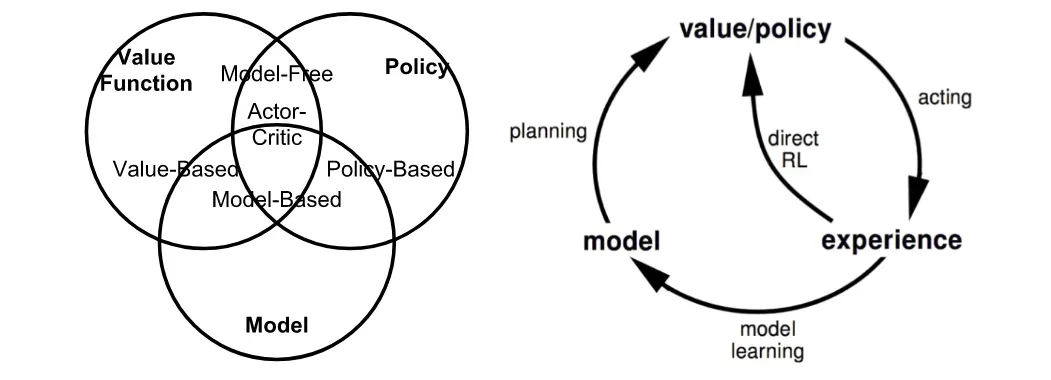
So my updated understanding is: Value functions are a central idea in many classic RL methods, but they are not the only object an RL algorithm can learn. A better way to classify RL algorithms is to ask 2 questions:
- Does the agent use the model of the environment?
- What does the agent learn: a value function, a policy, a model, or some combination of them?
I’ll leave these questions for the future me to answer. In the meantime, I also recommend the diagram of the taxonomy of RL Algorithms in OpenAI Spinning Up:

Intuition on Value Function
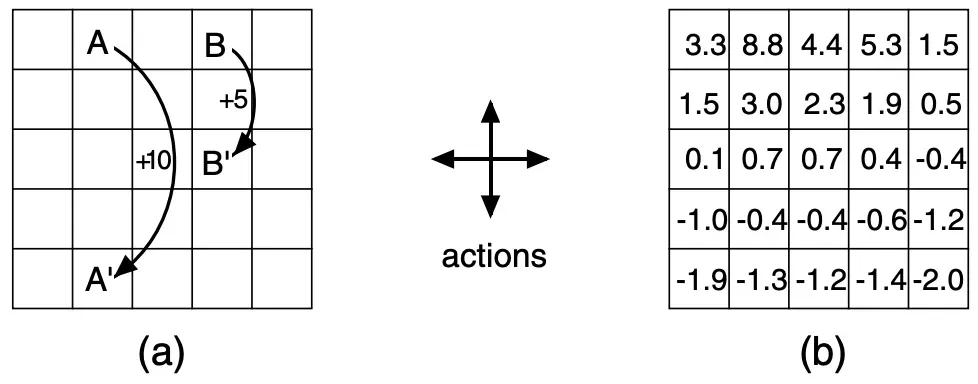
I want to use the “Example 3.8 GridWorld” in Reinforcement Learning: An Introduction to build intuition for the value function.
The rules of GridWorld game are as follows.
(1) Actions
From any cell, the agent can choose 1 of 4 actions:
northsouthwesteast
Each action tries to move the agent one cell in that direction.
(2) Border
If the next state would be outside the grid, the agent stays in the same cell and receives reward -1.
(3) Special States
- If the agent is in cell
A, any action you moves it toA'and gives reward+10. - If the agent is in cell
B, any action you moves it toB'and gives reward+5.
(4) Normal States
All other valid moves give reward 0.
The value of a state means the expected discounted future reward starting from that state, under a given policy. In this example, the policy is the random policy: each action has probability .
Looking at figure (b), we can form the following intuition:
- Cells
AandBhave the highest values because they give special positive rewards. - Cells near
AandBalso have relatively high values because the agent may reach those special states soon. - Cells near the wall have lower values because the agent has a higher chance hitting the border and receiving
-1.
From Value Function to Bellman Equation
Let’s walk through the derivation of value function and the Bellman equation mentioned in the Reinforcement Learning: An Introduction.
Here’s my updated notation based on my reading mixing up Reinforcement Learning: An Introduction, Algorithms for Decision Making, OpenAI Spinning Up, and David Silver’s course in UCL.
RemarkThe notation is slightly different from the original Sutton’s notation.
- I will use for the return and for the one-step reward. This avoids mixing up “reward” and “return”.
- The return is
- The discount factor is .
We also have this equivalent notations:
Let’s break down each step.
(1)
The value of state following the policy is denoted as . It is equal to the expected return of the “total discounted reward” (or simply “return” ) starting from state .
In simple words: the value function tells us how good it is to be in a state, measured by future reward.
(2) Why do we need ?
Look at the equation we might raise this question.
The reason is that the reward sequence may never stop for continuing tasks. If the agent receives reward forever and , then
But with , we have
and therefore the return becomes finite.
RemarkHowever, we need to note that can still be valid for tasks that always terminate.
To conclude, the point is not “we always need ”, but rather discounting helps make infinite-horizon returns well-defined and also makes many Bellman updates converge nicely.
(3) Recursive structure
The key step is the from
This is where the recursive structure appears. The return from now is the immediate reward plus the discounted return from the next state. This is the heart of the Bellman equation.
RemarkThe also refers to Bellman backup which essentially is: the reward-plus-next-value.
(4) Expanding over actions and next states
The expression
means:
- first, average over all possible actions , according to the policy .
- then, average over all possible next states , according to the transition probability .
- for each transition, add the immediate reward and the discounted value of the next state.
RemarkOne minor but critical detail on the Sutton’s notation
Its modern equivalent is Meaning, the probability distribution over action conditioned on state .
(5) Bellman Equation
Finally, we have the Bellman equation. I intentionally list out the variations I have seen as followed.
Reinforcement Learning: An Introduction:
Policy Evaluation
Let’s get our hands dirty.
The following code is my practice for evaluating the GridWorld environment. I asked kimi to write the skeleton of the quiz, leaving the step and policy_eval_sweep functions empty.
You can run this using uv run this-file.py
# /// script
# requires-python = ">=3.10"
# dependencies = [
# "numpy",
# ]
# ///
import numpy as np
# Environment Setup
ROWS, COLS = 5, 5
GAMMA = 0.9
ACTIONS = [(-1, 0), (1, 0), (0, -1), (0, 1)] # up,down,left,right
# Special States
A = (0, 1)
Ap = (4, 1)
B = (0, 3)
Bp = (2, 3)
def step(current_row, current_col, action) -> tuple[int, int, float]:
if (current_row, current_col) == A:
return (*Ap, 10.0)
if (current_row, current_col) == B:
return (*Bp, 5.0)
delta_row, delta_col = action
next_row = current_row + delta_row
next_col = current_col + delta_col
out_of_board = (
next_row < 0 or next_row >= ROWS or
next_col < 0 or next_col >= COLS
)
if (out_of_board):
return (current_row, current_col, -1.0)
return (next_row, next_col, 0.0)
def policy_eval_sweep(V_old: np.ndarray) -> np.ndarray:
V_new = np.zeros_like(V_old)
for row in range(ROWS):
for col in range(COLS):
total = 0.0
for action in ACTIONS:
update_row, update_col, immediate_reward = step(row, col, action)
total += immediate_reward + GAMMA * V_old[update_row, update_col]
V_new[row, col] = total / len(ACTIONS)
return V_new
# Initialize
V = np.zeros((ROWS, COLS))
theta = 1e-5
# Log
history = {0: V.copy()}
history_steps = [1, 2, 3, 10]
for k in range(1, 10_000):
V_new = policy_eval_sweep(V)
delta = np.max(np.abs(V_new - V))
V = V_new
if k in history_steps:
history[k] = V.copy()
if delta < theta:
print(f"converged after {k} sweeps")
history_steps.append(k)
history[k] = V.copy()
break
# Print grid
def print_grid(V: np.ndarray, title: str, decimals: int = 1) -> None:
print(f"\n=== {title} ===")
# Check with fig 3.5(b) in RL-Sutton
for r in range(ROWS):
row_str = ""
for c in range(COLS):
val = V[r, c]
if abs(val) < 0.05:
row_str += f" {0:5.1f} "
else:
row_str += f" {val:5.1f} "
print(row_str)
# show key steps
converged_step = history_steps[-1]
for k in history_steps:
if k == converged_step:
print_grid(history[k], f"k = {k} (converged)")
else:
print_grid(history[k], f"k = {k}")
# compare with Figure 3.5(b)
print("\n=== compare with Figure 3.5(b) (converged) ===")
figure_3_5_b = np.array([
[3.3, 8.8, 4.4, 5.3, 1.5],
[1.5, 3.0, 2.3, 1.9, 0.5],
[0.1, 0.7, 0.7, 0.4, -0.4],
[-1.0, -0.4, -0.4, -0.6, -1.2],
[-1.9, -1.3, -1.2, -1.4, -2.0]
])
print("Result")
print(np.round(history[converged_step], 1))
print("\n Figure 3.5(b):")
print(figure_3_5_b)
print("\n error(should be 0):")
print(np.round(history[converged_step], 1) - figure_3_5_b)Running this will yield an output that tracks the value propagation, converging at step 68.
=== k = 1 ===
  -0.5   10.0   -0.2    5.0   -0.5
  -0.2    0.0    0.0    0.0   -0.2
  -0.2    0.0    0.0    0.0   -0.2
  -0.2    0.0    0.0    0.0   -0.2
  -0.5   -0.2   -0.2   -0.2   -0.5

=== k = 2 ===
   1.5    9.8    3.1    5.0    0.3
  -0.5    2.2   -0.1    1.1   -0.5
  -0.4   -0.1    0.0   -0.1   -0.4
  -0.5   -0.1   -0.1   -0.1   -0.5
  -0.8   -0.5   -0.4   -0.5   -0.8

=== k = 3 ===
   2.3    9.6    3.8    4.9    0.7
   0.4    2.1    1.4    1.0   -0.1
  -0.6    0.4   -0.1    0.1   -0.6
  -0.7   -0.2   -0.1   -0.2   -0.7
  -1.1   -0.7   -0.6   -0.7   -1.1

=== k = 10 ===
   3.3    8.9    4.4    5.3    1.4
   1.5    3.0    2.2    1.8    0.5
   0.0    0.7    0.7    0.3   -0.4
  -0.9   -0.4   -0.3   -0.5   -1.1
  -1.8   -1.3   -1.1   -1.3   -1.8

=== k = 68 (converged) ===
   3.3    8.8    4.4    5.3    1.5
   1.5    3.0    2.3    1.9    0.5
   0.1    0.7    0.7    0.4   -0.4
  -1.0   -0.4   -0.4   -0.6   -1.2
  -1.9   -1.3   -1.2   -1.4   -2.0
RemarkThis section is just a sneak peek on “policy evaluation”, i.e., how to calculate the value function. For much more in-depth walk through, see How to Compute a Value Function? Policy Evaluation.